Heartfinity: A Playful Handwritten Display Font for Makers
There’s that quiet moment—just after the wax has cooled on a new candle batch—when I open my design software, scroll through my font library, and pause at Heartfinity. Not because it’s flashy or loud, but because it feels like picking up a favorite pen: soft, intentional, full of warmth. I’m sketching label mockups for lavender-vanilla soy candles, and Heartfinity instantly lifts the design—tall, friendly letters with gentle curves and just enough handmade charm to say “crafted with care” before anyone even reads the scent name.
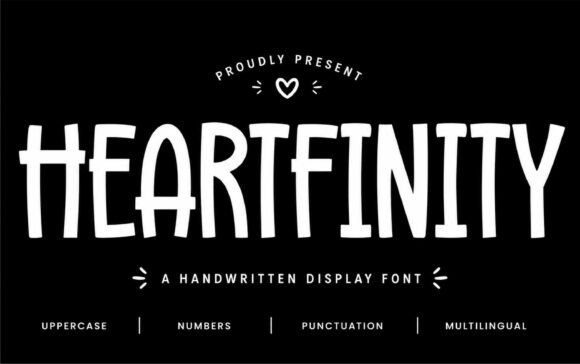
Heartfinity is a handwritten display font built for makers who value authenticity over perfection. Its characters sit taller than average, giving breathing room and presence—even at small sizes. The shapes are playful but not childish: think rounded terminals, subtle bounce in the baseline, and an organic flow that avoids rigid uniformity. It’s modern without being sterile, handmade without feeling messy. That balance is why it works so well across physical and digital handmade products—from sticker sheets cut on a Cricut to printable wedding welcome boards shared via Etsy download.
I first used Heartfinity on a set of seasonal greeting cards—spring birthdays, Mother’s Day, and little notes tucked into boutique gift boxes. Because it’s a display font, it shines best where impact matters most: headlines, names, short phrases, and decorative accents. It’s not meant for long paragraphs (no serif or sans serif would ask you to set body text in it), but it *is* perfect for “You’re Loved,” “Hand-Poured in Maine,” or “Est. 2022” stamped on kraft tags or pressed into clay charms.
For packaging, I’ve paired Heartfinity with a clean, neutral sans serif—like Montserrat Light or Inter Regular—for ingredient lists and care instructions. The contrast feels intentional: Heartfinity brings heart; the sans serif brings clarity. On candle labels, that pairing helps customers connect emotionally *first*, then trust the details. Same goes for wedding stationery—I use Heartfinity for couple names and ceremony titles, then switch to a delicate serif (think Playfair Display) for date and location. The result? A cohesive, elevated look that feels personal, not generic.
It also translates beautifully to digital printables. When designing planner pages or printable wall art, Heartfinity adds instant character without overwhelming the layout. A simple “Breathe” or “Gather Joy” in Heartfinity, centered on a linen-textured background, becomes a quiet anchor in someone’s daily routine. For sticker sheets, I test readability at 0.5" height—Heartfinity holds up well thanks to its generous x-height and open counters. Just avoid ultra-thin cuts or tight spacing when using it with vinyl or paper cutters; a slight stroke expansion in your design software helps prevent breakage.
Seasonal projects are where Heartfinity really sings. Last December, I designed holiday tags with phrases like “For You, With Love” and “Merry & Made.” Printed on recycled cardstock and tied with twine, they looked thoughtful—not mass-produced. For spring, I used it on farmhouse-style signs (“Grow Kindness,” “Hello, Sunshine”) laser-cut from birch plywood. The font’s natural rhythm echoes hand-lettered wood signs, but with more consistency across batches—ideal when you're making multiples for a local market or online shop.
When choosing Heartfinity for merchandise—like mugs, tote bags, or tees—I always preview at actual size. On a curved ceramic surface, letter spacing tightens visually, so I’ll loosen tracking by 20–30 units in Illustrator. For fabric printing, I avoid fine interior details (like delicate swashes) unless the print method supports high resolution. Thankfully, Heartfinity includes standard OpenType features—ligatures, stylistic alternates, and basic multilingual support (Latin-1 extended)—so swapping in a prettier “&” or adjusting a lowercase “a” is just a click away.
One thing I always double-check before listing anything commercially: the license. Heartfinity is a commercial font, meaning it’s cleared for use on physical products you sell, digital templates you distribute, and SVG files for cutting machines—no hidden restrictions. But I still glance at the included file formats (.OTF, .TTF, sometimes .WOFF for web use) and confirm multilingual glyphs cover my audience’s needs (e.g., accented characters for French or Spanish greetings). It’s a small step that saves headaches later—especially if you’re designing bilingual wedding invites or international printable bundles.
What makes Heartfinity feel different isn’t just how it looks—it’s how it behaves in real workflows. It imports cleanly into Canva, Silhouette Studio, and Adobe apps. It scales gracefully from 12pt on a tiny tea bag tag to 200pt on a 24"x36" printable poster. And because it’s intentionally handmade—not overly digitized or “perfect”—it pairs naturally with textures: watercolor backgrounds, grainy paper scans, linen overlays, even chalkboard mockups.
If you’re building brand identity for your handmade shop, Heartfinity can be your secret emotional connector. It doesn’t shout—but it lingers. Customers remember how something *felt* before they remember what it said. A greeting card with Heartfinity in the signature line, a mug with “Good Morning, Friend” looping across the front, a wedding invitation suite where the couple’s names bloom like handwritten petals—these aren’t just designs. They’re tiny moments of recognition, warmth, and craft made visible.
So next time you’re staring at a blank canvas—whether it’s a label template, a sticker sheet, or a digital download preview—try Heartfinity. Not as decoration, but as intention. Let the tall, joyful letters do the quiet work of saying, “This was made for you.”